Overview of Cryptology
Cryptology (from the Greek kryptós, meaning “hidden” or “secret”, and lógos, meaning “study” or “word”) is the formal scientific and mathematical discipline dedicated to secure communications, data protection, and information security in the presence of adversarial third parties.
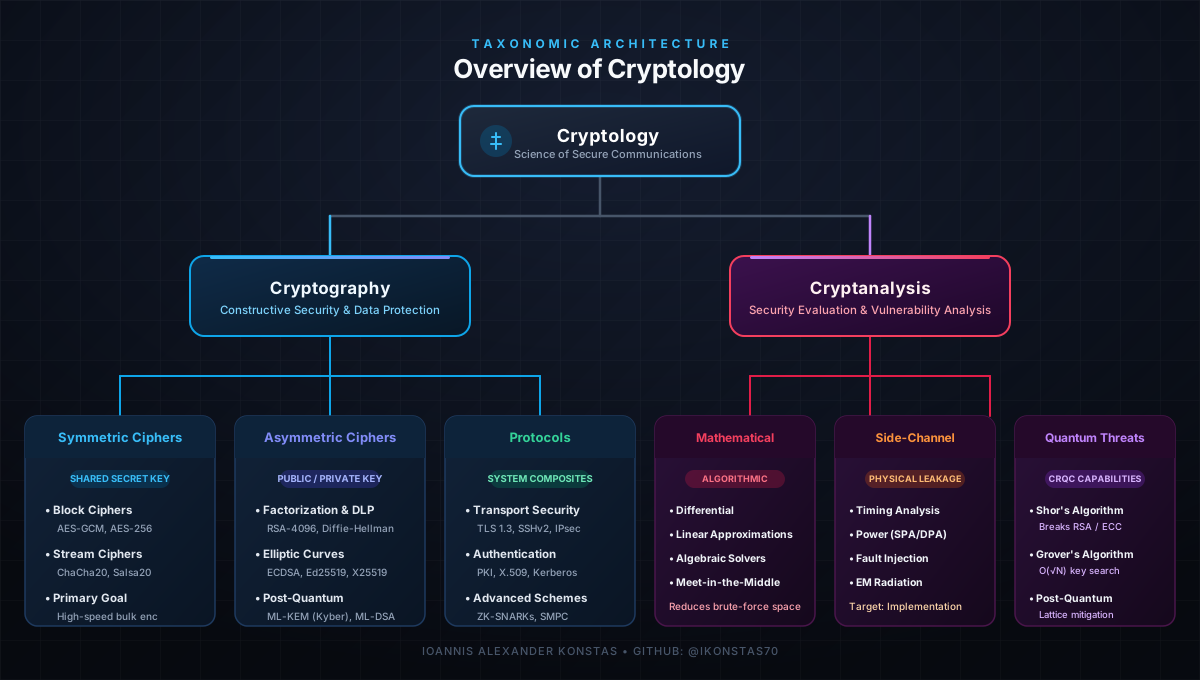
1. The Cryptology Topology
The domain of cryptology is fundamentally bifurcated into two complementary and opposing branches:
- Cryptography: The constructive engineering and mathematical discipline of designing secure primitives, algorithms, key agreements, and network protocols.
- Cryptanalysis: The analytical discipline of discovering mathematical weaknesses, evaluating physical side-channel leakages, and establishing provable security boundaries.
                                  ┌────────────────────────┐
                                  │       Cryptology       │
                                  └───────────┬────────────┘
                                              │
                     ┌────────────────────────┴────────────────────────┐
                     ▼                                                 ▼
          ┌────────────────────┐                            ┌────────────────────┐
          │    Cryptography    │                            │   Cryptanalysis    │
          └──────────┬─────────┘                            └─────────┬──────────┘
                     │                                                │
       ┌─────────────┼─────────────┐                  ┌───────────────┼───────────────┐
       ▼             ▼             ▼                  ▼               ▼               ▼
┌─────────────┐┌─────────────┐┌─────────┐      ┌─────────────┐ ┌─────────────┐ ┌─────────────┐
│  Symmetric  ││ Asymmetric  ││Protocols│      │Mathematical │ │Side-Channel │ │   Quantum   │
│   Ciphers   ││   Ciphers   ││(TLS/SSH)│      │ (Diff/Linear)│ │(Power/Time) │ │(Shor/Grover)│
└─────────────┘└─────────────┘└─────────┘      └─────────────┘ └─────────────┘ └─────────────┘
2. Cryptography: Primitives and Constructions
2.1 Symmetric Ciphers (Secret-Key Cryptography)
In symmetric cryptography, communicating parties share a single private key K for both encryption and decryption:
Ciphertext = Encrypt_K(Plaintext)
Plaintext  = Decrypt_K(Ciphertext)
Because symmetric operations utilize highly optimized substitution-permutation networks (SPN) or ARX operations (Addition-Rotation-XOR), they exhibit massive computational throughput and form the engine for encrypting bulk data at rest and in transit.
- Block Ciphers: Encrypt fixed-size data blocks (e.g., 128-bit blocks). Standard: AES (Advanced Encryption Standard / Rijndael) in 128, 192, and 256-bit key variants. Operating modes like GCM (Galois/Counter Mode) provide Authenticated Encryption with Associated Data (AEAD).
- Stream Ciphers: Generate an infinite pseudorandom keystream XORed bit-by-bit with the plaintext stream. Standard: ChaCha20-Poly1305, delivering exceptional performance across architectures without hardware-accelerated AES instructions.
2.2 Asymmetric Ciphers (Public-Key Cryptography)
Asymmetric cryptography eliminates the requirement for a pre-shared secret key by leveraging trapdoor one-way functions—mathematical operations that are computationally easy to compute in the forward direction but intractable to reverse without secret auxiliary information.
- Public Key (PK): Freely published; used to encrypt plaintexts or verify digital signatures.
- Private Key (SK): Kept secret; used to decrypt ciphertexts or generate digital signatures.
| Mathematical Problem | Representative Primitives | Primary Applications |
|---|---|---|
| Integer Factorization (IFP) | RSA (2048 / 4096-bit) | Legacy PKI, digital signatures, key transport |
| Discrete Logarithm (DLP) | Diffie-Hellman (DH), ElGamal, DSA | Key agreement, asymmetric encryption |
| Elliptic Curves (ECDLP) | ECDH, ECDSA, Ed25519, X25519, secp256k1 | High-efficiency key exchange, Bitcoin, TLS 1.3 |
| Lattice-Based Post-Quantum | ML-KEM (Kyber), ML-DSA (Dilithium) | Quantum-resistant key encapsulation and signing |
2.3 Cryptographic Protocols
Cryptographic protocols orchestrate underlying symmetric and asymmetric primitives into structured multi-step communication flows to satisfy composite security models:
- Transport Layer Security (TLS 1.3): Combines asymmetric key exchange (X25519 / ECDHE), X.509 PKI certificates for identity authentication, and AEAD symmetric ciphers (AES-256-GCM) for wire encryption.
- Secure Shell (SSHv2) & IPsec / WireGuard: Robust host authentication and network-layer tunneling protocols.
- Privacy-Enhancing Protocols: Zero-Knowledge Proofs (zk-SNARKs/zk-STARKs) and Secure Multi-Party Computation (SMPC) enabling computation over secret inputs without disclosing private data.
3. Cryptanalysis: Vectors & Threat Models
Cryptanalysis investigates the vulnerabilities of cryptographic schemes across three distinct boundaries:
3.1 Mathematical & Algorithmic Cryptanalysis
- Differential Cryptanalysis: Tracks the evolution of differences between pairs of plaintexts through successive cipher rounds to recover internal round keys.
- Linear Cryptanalysis: Fits linear affine approximations over non-linear substitution boxes (S-boxes) to determine key bits with statistical advantage.
- Algebraic Attacks: Expresses the entire cipher structure as a large system of multivariate polynomial equations solved via Gröbner bases or SAT solvers.
3.2 Implementation & Side-Channel Attacks (SCA)
Rather than attacking theoretical mathematical hardness, Side-Channel Attacks exploit physical phenomena emitted during physical execution:
- Timing Attacks: Variations in CPU execution duration (e.g., non-constant-time modular exponentiation or string comparison) leak key bits.
- Power Analysis (SPA / DPA): Monitoring instantaneous micro-watt power consumption fluctuations during cryptographic operations.
- Fault Injection: Inducing physical clock glitches, laser pulses, or voltage drops to provoke computation faults that output corrupted signatures, allowing private key reconstruction.
3.3 Quantum Cryptanalysis
- Shor’s Algorithm: Solves prime factorization and discrete logarithms in polynomial time
O((log N)³), rendering RSA, Diffie-Hellman, and Elliptic Curve Cryptography completely broken once Cryptographically Relevant Quantum Computers (CRQCs) emerge. - Grover’s Algorithm: Provides a quadratic speedup
O(√N)for brute-force symmetric key search, reducing effective security of an N-bit key to N/2 bits (countered globally by standardizing on 256-bit symmetric keys).
4. Summary Matrix
| Pillar | Discipline | Core Primitive / Vector | Standard Metric |
|---|---|---|---|
| Cryptography | Symmetric Ciphers | AES-256-GCM, ChaCha20 | 128–256 bit key entropy |
| Cryptography | Asymmetric Ciphers | RSA, X25519, ML-KEM | Computational hardness of IFP/DLP/LWE |
| Cryptography | Protocols | TLS 1.3, SSH, WireGuard, ZKPs | IND-CCA2, Perfect Forward Secrecy |
| Cryptanalysis | Mathematical | Differential & Linear Attacks | Advantage ε over random permutation |
| Cryptanalysis | Side-Channel | Timing, DPA, Faults | Physical signal-to-noise ratio (SNR) |
| Cryptanalysis | Quantum | Shor's and Grover's Algorithms | Quantum circuit depth & physical qubits |